

Small businesses in 2026 operate very differently from how they did just a few years ago. Sales cycles are faster, customers expect quicker responses, and teams are smaller but more stretched. At the same time, technology has quietly become more powerful. For example, automation has become smarter, systems are more connected, and tools are expected to work with minimal setup.
This shift has changed the role of CRM systems. A modern CRM is no longer just about managing contacts or tracking deals. It now works closely with CPQ (Configure, Price, Quote) processes to help businesses create accurate offers, respond faster to inquiries, and avoid pricing mistakes. For many small and medium-sized businesses, CRM and CPQ together form the core of daily sales operations.
This article explains how CPQ fits into modern CRM workflows, what problems it actually solves, and how to decide if it makes sense for their business today.
Start With the Real Business Problem

Most Swiss small and medium sized businesses don’t lose deals because their products or services are weak. They lose deals because quoting takes too long, pricing is unclear, or mistakes slip in.
A familiar situation looks like this: Pricing rules, records, and plans are stored in Excel files. Some discounts exist only in people’s heads. Sales teams promise things that the operations team later struggles to deliver. Over time, margins quietly shrink because no one sees the full picture.
In Switzerland, this hurts more than in many other markets. Labor costs are high, customers expect accuracy, and trust is hard to rebuild once lost. That is where CPQ comes in, a tool for better control and risk reduction.
What is CPQ?
CPQ stands for Configure, Price, Quote, which helps teams generate accurate quotes on the first attempt.
In simple terms, CPQ makes sure quotes are:
- Technically correct
- Priced correctly
- Created quickly
This is especially important when products, services, or pricing rules are complex.
A good CPQ system connects speed with accuracy. Everyone works with the same data, the same pricing logic, and the same rules. Sales, operations, and finance stay aligned, without endless emails, approvals, or last-minute corrections.
Who Actually Needs CPQ (and Who Doesn’t)
CPQ is a good fit when:
- Products or services have options, bundles, or dependencies
- Prices change based on customer type, volume, contract length, or region
- Sales teams create custom quotes and negotiate discounts
- Approvals are needed to protect margins
Not every business needs CPQ. If quoting is already simple, CPQ may add cost without much benefit, so it’s best to be clear about the need from the start. CPQ is usually unnecessary when:
- You sell one fixed-price product
- Every quote looks the same
- Pricing rarely or never changes
Swiss SMBs value clear scope and practical decisions. CPQ should remove friction and risk, not add another layer of complexity.
CPQ Works Best as Part of the CRM Process
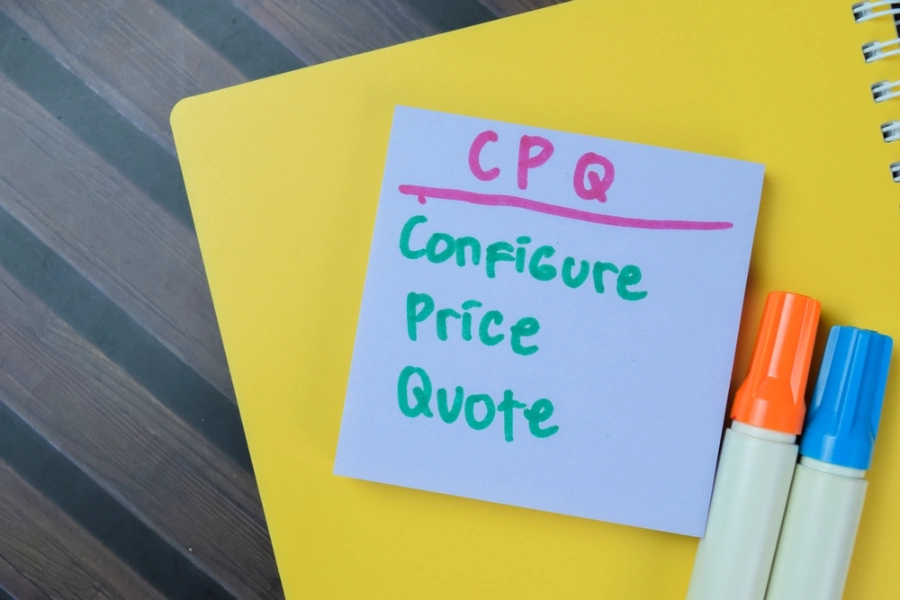
CPQ creates the most value when it works inside the CRM sales process rather than as a standalone tool.
CPQ creates the most value when it works inside the CRM sales process rather than as a standalone tool.
A clean and effective flow looks like this:
Lead → Opportunity → Configuration → Pricing → Quote → Order
When CPQ is connected to CRM, product data, and finance rules, teams stop retyping information and start working with confidence. Quotes are built on reliable data, prices follow clear rules, and everyone sees the same numbers.
This reduces errors, saves time, and builds confidence across sales, operations, and finance. Instead of fixing mistakes later, teams get things right from the start.
This process-first approach fits well with platforms like Büro-365, where structure and clarity come before automation. The goal of Büro 365 is to make work smooth from first contact to final order.
Key CPQ functions that will matter in 2026
A CPQ system doesn’t need dozens of features to be useful. In 2026, the focus will be on productivity and quality, not on bloated features.
Guided product setup
The system guides sales teams step by step and blocks invalid product combinations. This reduces confusion and avoids commitments the business cannot fulfil later.
Clear, rule-based pricing
Prices follow defined rules based on volumes, customer types, or contract terms. No hidden Excel files. No last-minute manual overrides. Everyone works with the same pricing logic.
Smart discount and approval control
Discount limits are clear, and approvals happen automatically when needed. This protects margins and removes long email chains and delays.
Fast, professional quotes
Quotes are clean, branded, and easy to understand. Customers see clear options, prices, and terms without confusion.
Reliable data flow
Data stays consistent between CPQ, CRM, and ERP systems. No copy-paste work. Fewer errors. Less rework for sales and finance teams.
Why CPQ Is Especially Important in Switzerland

Swiss customers expect accuracy. Small pricing or configuration mistakes can highly damage the customer trust faster. CPQ helps ensure that every quote is correct, consistent, and reliable.
Manual quoting also costs real money. When skilled employees spend hours checking prices or fixing errors, labor costs rise quickly. CPQ reduces this repeated work and frees teams to focus on real value.
Many Swiss businesses also operate across regions and languages. CPQ supports different pricing logic and formats without creating chaos.
Common CPQ Mistakes to Avoid
CPQ is powerful, but it doesn’t fix broken processes. If your products, pricing, or approvals are messy, CPQ will only make the issues more visible.
Some common mistakes small Swiss businesses make:
- Buying CPQ before products and pricing rules are clearly defined
- Customizing every detail from day one
- Using CPQ only as “just a quoting tool” without process improvements
- Implementing CPQ without connecting it to CRM or operations
A simple principle helps: get the structure right first, then use automation tools. This ensures CPQ supports the team instead of creating more work.
A Practical Way to Adopt CPQ

Swiss SMBs succeed with CPQ when adoption is gradual and deliberate. A step-by-step approach works best:
- Standardize products and pricing: Make sure everyone uses the same product options and pricing rules.
- Clean up CRM data: Accurate customer and product data is essential for CPQ to work properly.
- Start with the most common offerings: Begin with standard configurations before mapping highly complex special cases.
- Add automation gradually: Automate repetitive tasks step by step without overwhelming the team.
- Train sales teams on the “why,” not just the “how”: When the sales team understands the rules, they trust the system and use it confidently.
This approach reduces resistance, avoids frustration, and helps CPQ become a trusted part of daily work rather than a complex tool no one wants to use.
Where CPQ Is Heading in 2026
CPQ continues to improve quietly. The focus is less on flashy features and more on practical help.
Top 2026 trends in CPQ include:
- Assisted with configuration based on past deals
- Smarter pricing suggestions
- Faster approvals through connected workflows
- Stronger links between CRM, CPQ, and operations
Die Richtung ist klar: weniger manuelle Entscheidungen, mehr Konsistenz.
Conclusion
CPQ helps protect profits, reduces mistakes, and makes business growth steady and predictable. For Swiss small and medium businesses, a good CPQ acts as:
- A scaling tool: It grows with your business without adding chaos
- Control system : It ensures that prices and configurations are always correct.
- A trust builder: It keeps customers confident in your accuracy
When quote creation becomes simple and reliable, teams can fully concentrate on customer service and growth again – without stress, errors, or unnecessary time expenditure.
FAQ
1. What is CPQ, and why do Swiss SMBs need it?
CPQ (Configure, Price, Quote) ensures every quote is correct, priced accurately, and generated quickly. It helps protect margins, reduce errors, and save time for small teams.
2. Does every small business need CPQ?
Not always. CPQ is useful when products or services have options, bundles, or variable pricing. For simple, fixed-price offerings, a basic quoting process may be enough.
3. How does CPQ improve quoting accuracy?
CPQ enforces rules for pricing, discounts, and product configurations. It prevents mistakes and avoids mismatched promises.
4. Can CPQ work with my existing CRM or accounting tools?
Yes. The most effective CPQ systems integrate with CRM, ERP, and finance tools, keeping data consistent and reducing manual work.
5. How should Swiss SMBs adopt CPQ?
Proceed step by step: Standardize products/prices, clean up your CRM data, start with core configurations, and introduce automation and team training in stages.





 English
  German